Custom web design that makes your value obvious.
Service overview · Last updated July 22, 2026
We turn strategy, content, and customer intent into a distinctive website people can understand and use. Every layout has a purpose; every interaction supports the next decision.
We work with B2B, ecommerce and local service businesses. If you run a trade that lives on local search, see our web design for service contractors hub.
At a glance
- Timeline
- Scoped in discovery, then fixed in the written proposal.
- Deliverables
- 9 documented deliverables — see the full list
- Reporting
- Progress reviewed against the goals agreed in discovery.
On this page
Custom web design is the practice of shaping a website's structure, visual system, and interactions around a specific audience, business model, and set of measurable goals — not a marketplace theme. It combines discovery, information architecture, responsive UI, and a documented component library, so the finished site is easier to understand, cheaper to extend, and honest about what it wants each visitor to do next.
This approach also gives pressure washing companies a clear path from local search to a quote request.
The same structure carries into website design for therapists, where the visitor is choosing a person rather than comparing quotes.
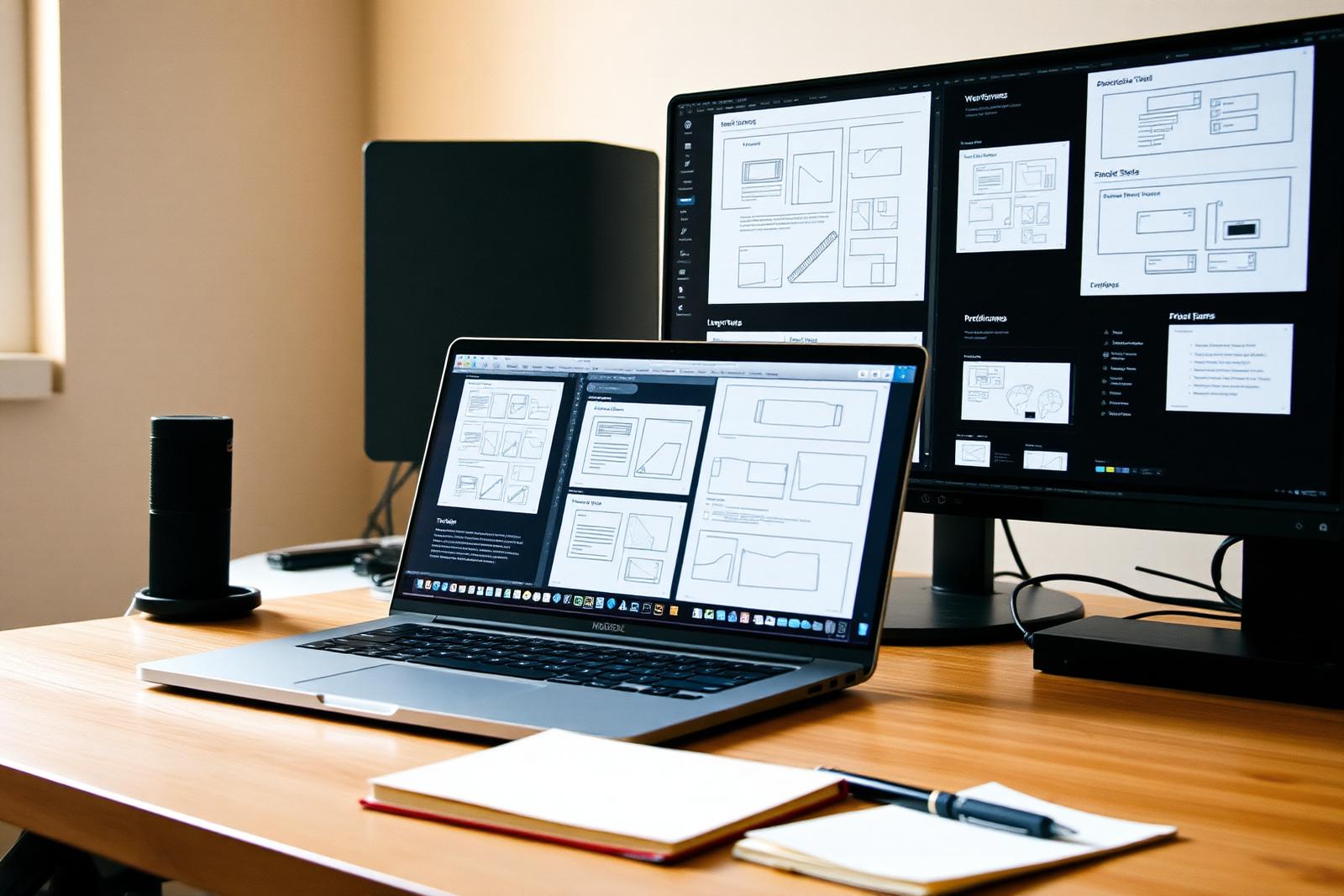
What does a custom web design engagement actually deliver?
A custom web design engagement delivers a documented information architecture, a responsive visual system, and a component library ready for development. The result is a site that reads clearly on any device, sets a consistent brand impression, and gives your team a foundation they can extend without hiring us back for every change.
- A stronger, more memorable first impression
- Clearer navigation for real audiences
- A consistent brand experience across devices
- A system that is easier to expand later
A custom web design engagement delivers a documented information architecture, a responsive visual system, and a component library ready for development.
What's included in a custom web design project?
Every web design project includes discovery, competitor and audience mapping, sitemap, wireframes at mobile and desktop widths, a responsive UI system with typography and color tokens, and a documented component library handed off to development. Accessibility review and a developer handoff pack are standard, not upsells.
- Discovery workshop
- Competitor review
- Audience journey maps
- Sitemap and IA
- Wireframes
- Responsive UI design
- Design system & component library
- Accessibility review
- Developer handoff pack
What's explicitly not included?
A design engagement stops at a validated visual system and handoff pack. If you need any of the below, we scope them as separate line items so the design budget stays honest.
- Full long-form copywriting for every page
- Original photography or video production
- Custom illustration series or 3D artwork
- Front-end build and CMS integration (that's Web Development)
- Ongoing content updates after launch (that's Website Care)
How does a web design engagement work, step by step?
A design engagement moves through five clear phases with an approval gate at each transition. You always know what we are working on, what we are waiting on, and what decision unlocks the next step.
- 01
Discover: goals, audience, competitors
- 02
Structure: sitemap and journeys
- 03
Wireframe: layout and priority
- 04
Visual design: system, components, screens
- 05
Handoff: documented, ready for build
What does this look like on a real project?
A 25-person B2B software company arrives with a homepage that looks acceptable but converts poorly. The demo request rate sits under one percent and sales complains that inbound leads don't know what the product does.
The existing site has twelve pages of feature descriptions written by engineering, a generic hero, and no clear path from a first-time visitor to a scheduled demo. Marketing owns the site but has no budget to hire a full-time designer.
Step 1
Week 1 — Discovery
We run two 90-minute workshops: one with sales to hear how buyers actually describe the problem, one with three current customers to hear the words they use. We audit competitor sites for what buyers see next after leaving the site.
Step 2
Weeks 2–3 — Structure and wireframes
The twelve feature pages collapse into four use-case pages plus a product tour. Wireframes make the demo request the primary path on every page, with a secondary self-serve path for research-mode visitors who aren't ready to talk to sales.
Step 3
Weeks 4–6 — Visual system and screens
A restrained visual system replaces the stock icon library. Screens are designed at 375px first, then scaled. Each component is documented with variants and states so the future developer doesn't have to guess.
Step 4
Week 7 — Handoff
The client receives a component library, a spec pack for the developer they've chosen internally, and a two-hour walkthrough. The design work is done; build begins with no ambiguity.
Outcome
Six weeks after launch of the rebuilt site, demo request rate is measurably higher and sales reports a shorter first call because visitors arrive already understanding the category. The design system continues to serve new landing pages the marketing team builds themselves.
Custom design vs template vs page builder
| Marketplace template | Page builder | Custom design | |
|---|---|---|---|
| Upfront cost | Lowest | Low | Highest |
| Fits your specific audience | Rarely — designed for a category | Partially — constrained by the builder | Yes — built from your audience research |
| Cost to change later | High — usually a full rebuild | Medium — locked into the tool | Low — documented component library |
| SEO foundations | Whatever the template ships with | Whatever the platform allows | Planned from structure outward |
| Ownership | License terms of the marketplace | Tied to the platform's subscription | You own source files and code |
| Best fit | Personal projects, MVPs, one-off launches | Small brochures with occasional edits | Businesses whose website has to earn its cost back |
Questions we get about this service
Custom web design vs a template — which should a small business choose?+
Templates are fast and cheap but interchangeable, and a template's structure is set by whoever designed it for the marketplace. A custom system is planned around your audience, content, and business goals, so it stays useful as you grow and does not need a rebuild every time you add a product line.
How many design concepts will I see before we choose a direction?+
One considered direction, refined through two structured revision rounds — not a lottery of three throwaway comps. Concept lottery wastes budget and hides the fact that the strategy was never nailed down. We show one direction because we did the strategy work first.
How are revisions handled and what happens if we need more?+
Two structured revision rounds per key deliverable are included in every engagement. Additional rounds are scoped transparently by the hour with a written note explaining what changed the direction. You never receive a surprise revision invoice.
Do you design mobile-first?+
Yes. Layout, typography, and interactions are designed and validated at 320–375px before scaling up to tablet and desktop. Roughly 60% of most B2C traffic and 40% of most B2B traffic is on a phone; designing desktop-first quietly punishes those visitors.
Do you write copy or do we need a separate copywriter?+
We provide messaging direction, page structure, and copy briefs that a marketer or founder can fill in. Full copywriting can be scoped as an add-on, or handled by your team using the briefs. We do not ship placeholder Lorem Ipsum because it hides layout problems.
Who owns the design files, brand assets, and component library?+
You do. All Figma source files, exported components, style guide, and written documentation transfer to your team at project end with no ongoing license fee. Ownership is a contract term, not a favor.
How long does a custom web design engagement usually take?+
A focused marketing site is typically 5–8 weeks of design; a larger site with 15+ templates is 8–12 weeks. Timing depends on content readiness and how quickly your team can review each deliverable — feedback speed is the biggest schedule variable.
Ready to move on web design & ux?
Share the goal and current state—we'll respond with the clearest next step.