A clear first screen
Your first screen should name the service, the customer or location you serve, the reason to choose you and the next step. Clever copy can wait. Clarity earns the next scroll.
Pressure washing website design is what FloPixels does: fast, mobile-first sites for pressure washing, power washing and soft washing companies. We organize your services, service area, proof and quote path so the right visitor can understand what you do—and act—without hunting through the page.
By Florentina Gjoka, founder of FloPixels · Published 12 August 2026 · Updated 14 September 2026
Custom design · Local SEO foundations · Conversion measurement · Clear handoff
For owner-operated pressure-washing businesses, growing crews and multi-location exterior-cleaning companies that need a clearer way to turn search demand into enquiries.
Part of our web design for service contractors hub — see all industries we serve.
At a glance
Pressure washing web design is more than putting water-spray photos on a template. It is the structure, copy, visual proof and development of a website around the way homeowners and property managers choose an exterior-cleaning company.
A useful site answers four questions quickly: Do you provide the service I need? Do you work in my area? Can I trust the result? How do I request a quote? If one answer is buried, the visitor has a reason to go back to the search results.
FloPixels builds the page around those decisions. The result is not a promise of rankings or a guaranteed number of leads. It is a strong, measurable foundation: useful service pages, clear calls to action, credible proof, clean technical implementation and a journey that works on a phone.
In practical terms, your website should help a visitor:
Your first screen should name the service, the customer or location you serve, the reason to choose you and the next step. Clever copy can wait. Clarity earns the next scroll.
House washing, driveway cleaning, roof soft washing, deck cleaning and commercial pressure washing solve different problems. A useful page explains the surface, method, expected result, limitations, proof and quote step for that service.
Pressure washing is visual. We create a consistent project-gallery system for matched before-and-after images, descriptive captions, service type and location context. FloPixels will not invent reviews, jobs or results.
The first form should ask only for information you need. Name, contact details, service, property location and a short project note are usually enough. Add uploads or scheduling only when they improve qualification.
A service-area section helps visitors self-qualify. If individual city pages are part of the strategy, each one needs genuinely useful local information and proof—not a swapped city name on duplicated copy.
A roof-cleaning review belongs near roof-cleaning information. A commercial-facility testimonial belongs near the commercial offer. Real, specific proof works harder than generic five-star graphics.
We design readable type, comfortable tap targets, compressed images, stable layouts, simple forms and keyboard-accessible interactions. Motion respects reduced-motion preferences.
With consent handled correctly, track meaningful actions: quote submissions, phone-link clicks, email clicks and form errors. Traffic alone does not tell you whether the site helps win work.
Explore the wider FloPixels custom web design service.
These are self-initiated concepts built by FloPixels to show four different directions a pressure washing website can take. They are not client projects or live businesses — the brand names, contact details and reviews shown in them are placeholder content.
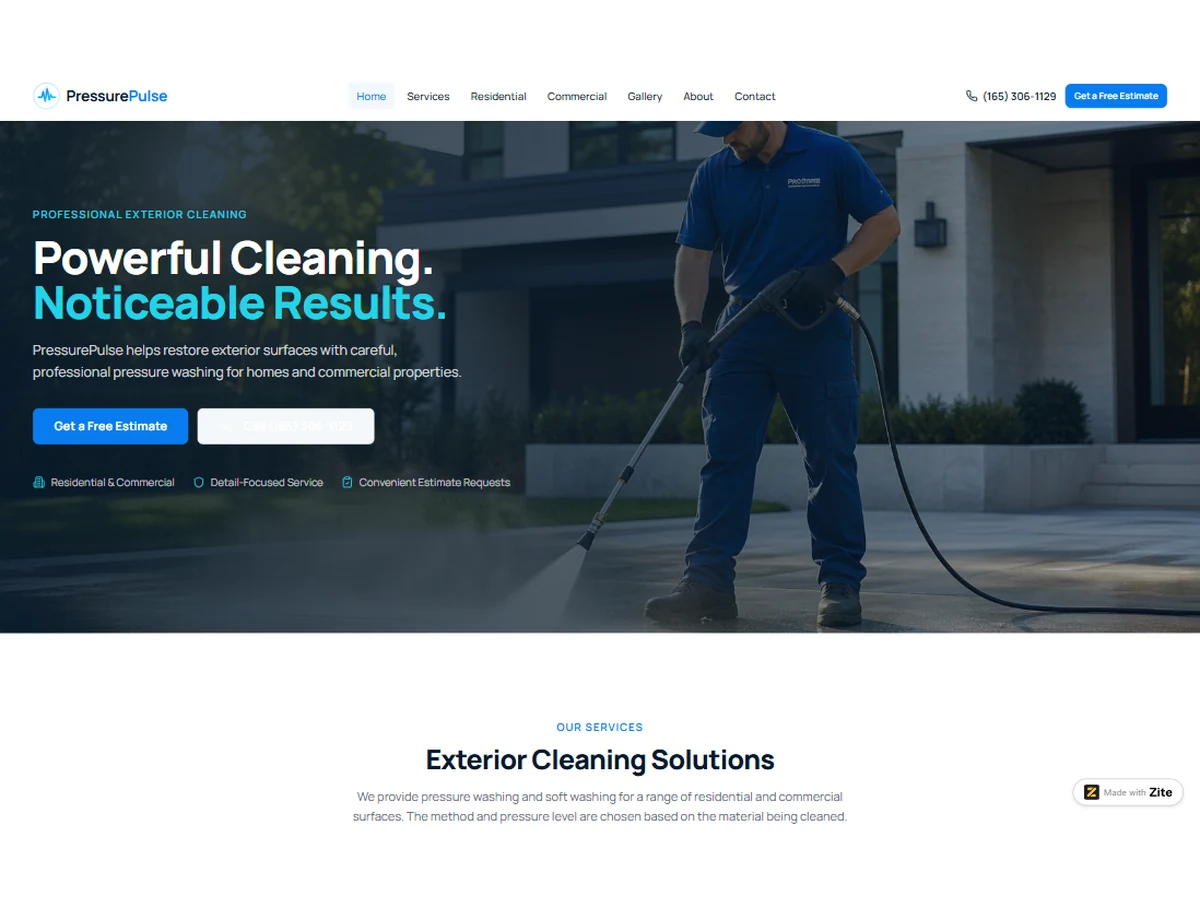
A broad direction for a company that cleans homes and commercial property under one brand. Eight services sit in a single grid, from house washing through to storefront and commercial property washing, with a dedicated service-area section so a visitor can confirm coverage before enquiring rather than after.
Best fit: established operators with a wide service list who need structure more than they need more pages.
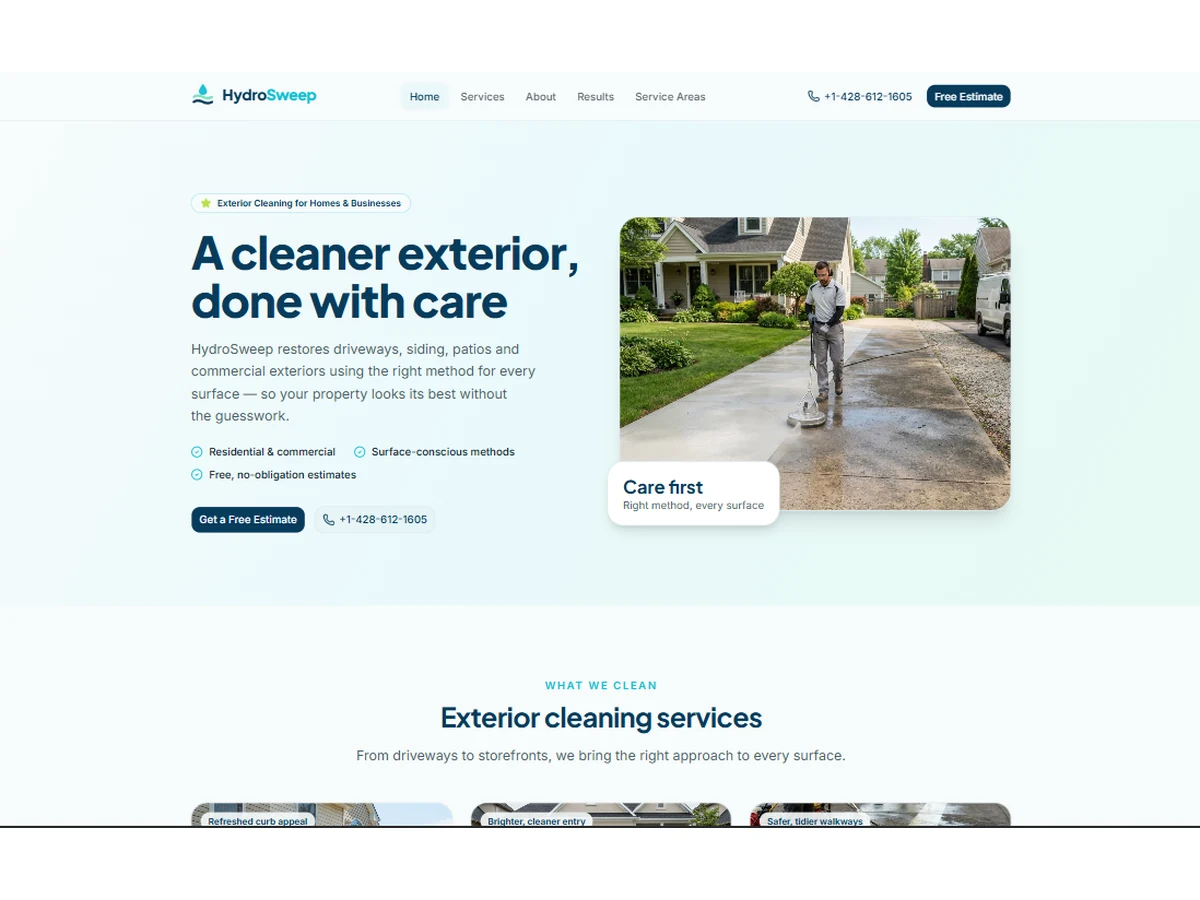
The most restrained of the four. Six residential services, a four-step estimate process, and copy that leads with the surface being cleaned rather than the equipment doing the cleaning. Nothing competes for attention, which suits a buyer comparing three quotes on a phone.
Best fit: owner-operated residential companies who want the site to feel considered rather than loud.
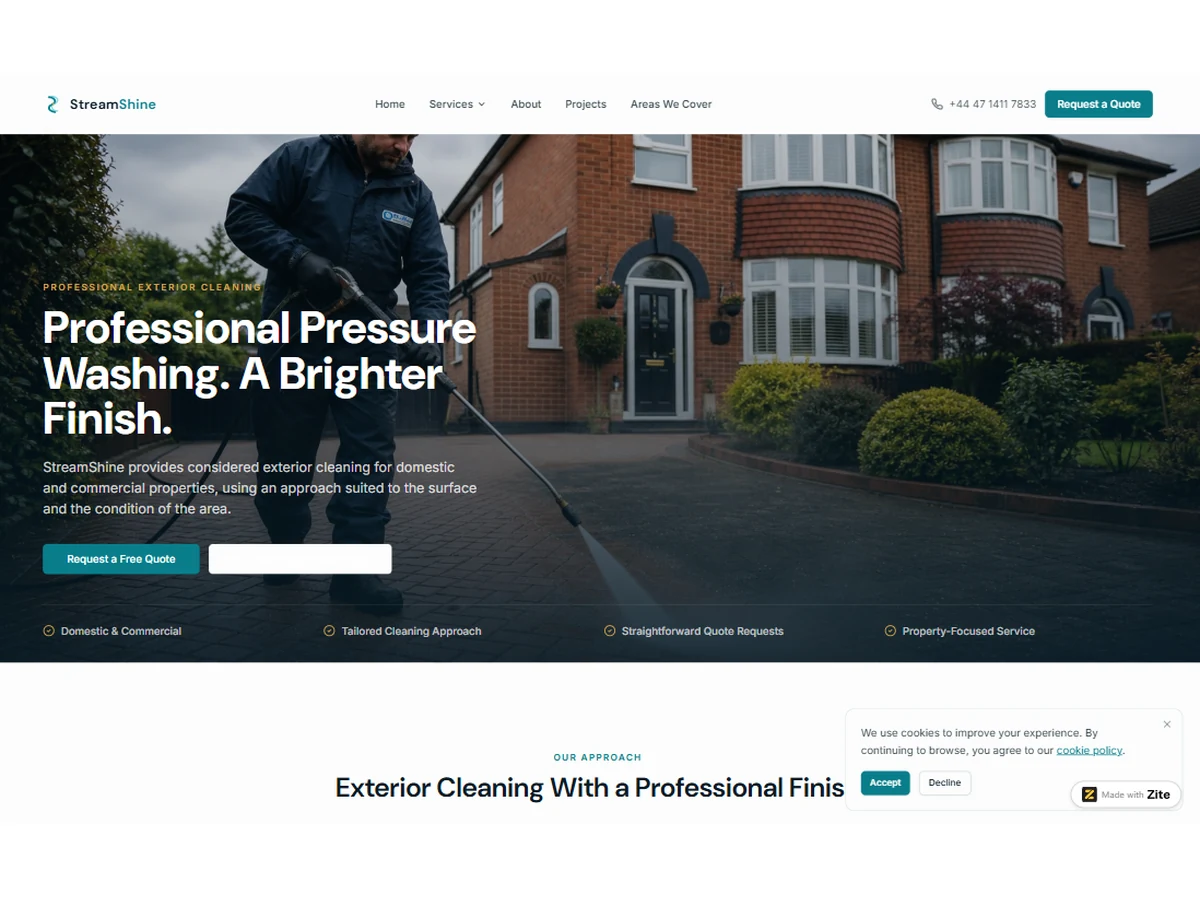
Built for a company whose work splits between domestic and commercial. The first real choice on the page asks what type of property the visitor has and sends them down a relevant path instead of averaging both audiences into one pitch. Forecourts, retail exteriors and warehouse areas each get their own treatment, and the process ends with a final walk-through.
Best fit: contractors pursuing commercial and industrial contracts alongside domestic work.
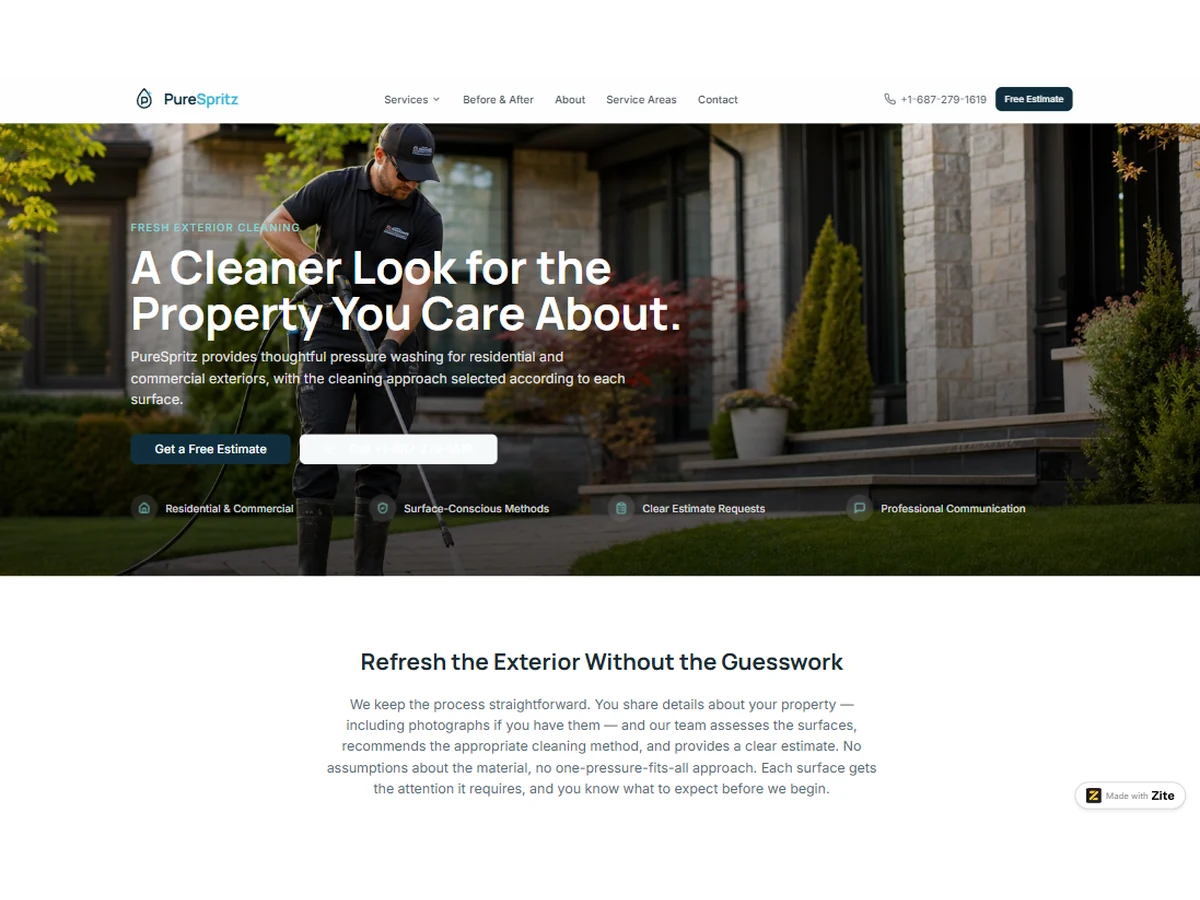
The only one of the four that explains the choice between pressure washing and soft washing as its own section, before the visitor picks a service. Estimates are photo-supported, so an enquiry arrives already qualified and the first call starts from the actual surface rather than a description of it.
Best fit: companies where surface damage is a genuine customer fear and the sales conversation starts with method.
No agency can quote you from a web page, and any that does is quoting a template. What they can do is tell you what actually moves the number — so you can judge a proposal instead of just comparing totals.
Page count is what most quotes are built on, and it's the least useful number in the conversation. What actually moves it:
Ongoing SEO is a separate purchase from a website build, and the two get confused constantly when people compare monthly costs. A website plan and an SEO retainer buy different things.
This is the question owners in this trade raise most often with each other, and almost no agency answers it on its website.
Before you pay anyone, get three things in writing:
None of this is a reason to avoid monthly plans. They're a sensible way to start when cash is tight. The mistake is discovering the terms two years in, after the site has become your main source of enquiries.
FloPixels' position: you own the domain, the code and the content from day one, and it's stated in the proposal, not just on this page.
Your scope should reflect your services and market, not an arbitrary page count. A typical project may include the following.
A pressure washing website should map one useful page to one clear search intent. The homepage carries the main brand and market promise. Service pages explain individual jobs. A service-area hub clarifies coverage. Substantial city pages can support important markets when each page contains real local value.
/
├── services/
│   ├── house-washing/
│   ├── roof-soft-washing/
│   ├── driveway-cleaning/
│   ├── deck-and-fence-cleaning/
│   └── commercial-pressure-washing/
├── service-areas/
│   ├── primary-city/
│   └── second-city/
├── projects/
│   └── descriptive-project-slug/
├── about/
├── reviews/
└── contact/
That is a planning example, not a requirement to publish every page at once. The right structure depends on your services, evidence, locations and capacity to maintain useful content.
We review the existing website, brand, services, service area, competitors, search visibility and enquiry flow. You receive a prioritized direction before visual design starts.
We map search intent to pages, define the navigation, choose the primary conversion, and list the photos, reviews, guarantees and facts needed for credible copy.
We develop the homepage and one representative service-page direction first. That establishes the message, visual system, mobile behavior and reusable components.
FloPixels develops the approved system, configures content fields, forms, analytics and technical SEO, and connects agreed tools.
We test routes, metadata, forms, keyboards, responsive layouts, images, redirects and tracking. The site launches with a handoff checklist and clearly assigned ownership.
After enough real traffic arrives, enquiry behavior can guide copy, CTA and page improvements. Tests need a clear hypothesis and enough data to be useful.
More on how FloPixels works and how projects are scoped.
The strongest pressure washing website uses real business evidence. Before design, gather what you have—not what you think an agency wants to hear.
If some items are missing, FloPixels will identify a practical placeholder or production plan. We will not fabricate proof to make a design look finished.
Cost depends on the number of distinct page types, copy requirements, custom design depth, CMS, integrations, migration risk and ongoing SEO scope. FloPixels provides a scoped estimate after reviewing your services, locations and current assets. We do not publish a made-up starting price merely to match competitors. The section above explains what moves a quote most.
There is no universal number. A focused operator may need a homepage, several service pages, a service-area page, about, projects and contact. A multi-location company may need more. Every indexable page should serve a distinct customer need and contain enough original value to stand on its own.
Technical and on-page foundations are included when named in the scope: crawlable pages, metadata, canonicals, image handling, internal links, sitemap controls, structured data and measurement setup. Ongoing content, Google Business Profile management, review work, citations and link acquisition are separate unless the proposal includes them.
FloPixels can plan an SEO-aware migration with a URL inventory, redirect map, metadata transfer, canonical checks, analytics continuity and post-launch monitoring. No migration is risk-free, but preserving valuable URLs and testing redirects reduces avoidable loss.
Yes. The service covers pressure washing, power washing, soft washing, roof cleaning and broader exterior-cleaning businesses. The language and page structure are adjusted to the methods, surfaces, buyer concerns and commercial mix of the business.
No credible agency can guarantee a specific organic position or lead volume. Search results, competition, reputation, demand, offer quality and follow-up all matter. FloPixels can build and improve the parts it controls, measure meaningful actions and explain the work without pretending to control Google or your market.
Yes, when a CMS is included in the scope. FloPixels models the content so common updates do not require redesigning the page. Permissions, training and ongoing support are agreed before launch.
Yes. With FloPixels, the domain is registered in your name, and the design, code and content are yours from day one. That's written into the proposal. We'd recommend asking the same three questions of any provider you're considering: whose name the domain sits in, who owns the work when the project ends, and what happens to the site if you stop paying.
A focused site is commonly 3–5 weeks from kickoff. A larger build with multiple service pages, service areas or a migration from an existing site is usually 6–10 weeks. The largest variable isn't design time — it's how quickly photos, service details and review permissions come back from you.
Sometimes, yes. If you're a solo operator with fewer than four services and you can write your own copy, a website builder will get you online and answering the phone for very little. Hiring makes sense when you have several services that each need their own page, when you're replacing a site that already ranks, or when the site has to work for both homeowners and property managers. If a builder is genuinely the better fit for where you are now, we'll say so.
Yes. FloPixels is remote-first and English-first, and most of our work is for companies in the US, UK and Canada. Working hours overlap with North American mornings, and projects run on video calls, written updates and shared documentation. Invoicing and contracts are handled in USD.
Tell FloPixels what you clean, where you work and what is holding your current site back. We will review the fit and outline the right first step for your pressure washing web design project.
Prefer email? Send your current URL, top three services and primary service area. That is enough to start a useful conversation.